Failure diagnostics: reading the damage on a gear
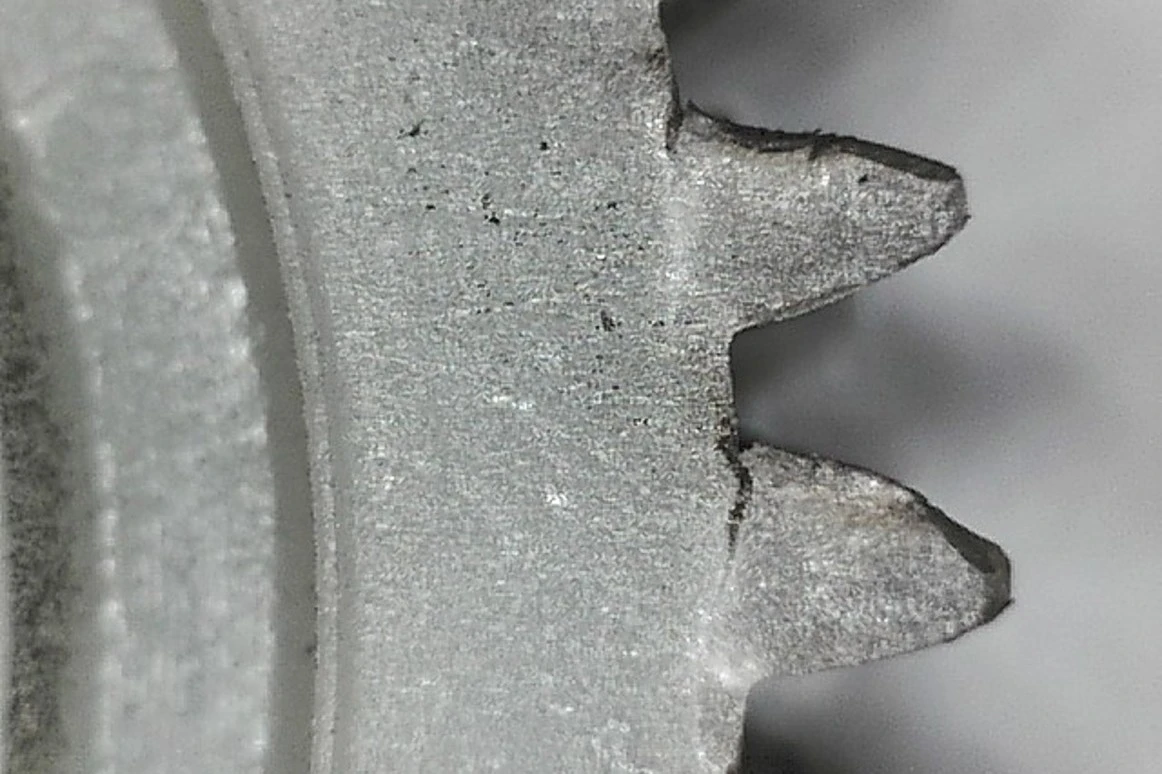
A technopolymer gear doesn't break in silence. Before the final failure, the teeth already tell what's going wrong: a few minutes of visual inspection are enough to read the cause and know what to correct.
Why do diagnostics
When a gear breaks, the natural reaction is to replace it. But doing so without analyzing the type of damage means almost certainly seeing the problem reappear after a few hundred hours. Each damage picture corresponds to a specific cause and a precise corrective action.
Pitting: surface fatigue
Appearance: small craters or pockmarks on the tooth flank, particularly in the zone of the pitch line. The surface looks pitted, as if struck by a punch at several points.
Diagnosis: surface fatigue of the material. The micro-cracks form below the surface due to the repeated cycles of contact pressure, and propagate until small fragments of material detach. It's a phenomenon of progressive degradation.
Probable cause: excessive load, with contact pressure exceeding the material's fatigue limit, or service life exceeded. The gear has worked beyond the design number of cycles.
Action: reduce the load, increase the module, evaluate a higher-strength material such as PA6 reinforced with 30% glass fiber (PA6+30%GF), or plan periodic replacement as a consumable component.
Scuffing: localized melting
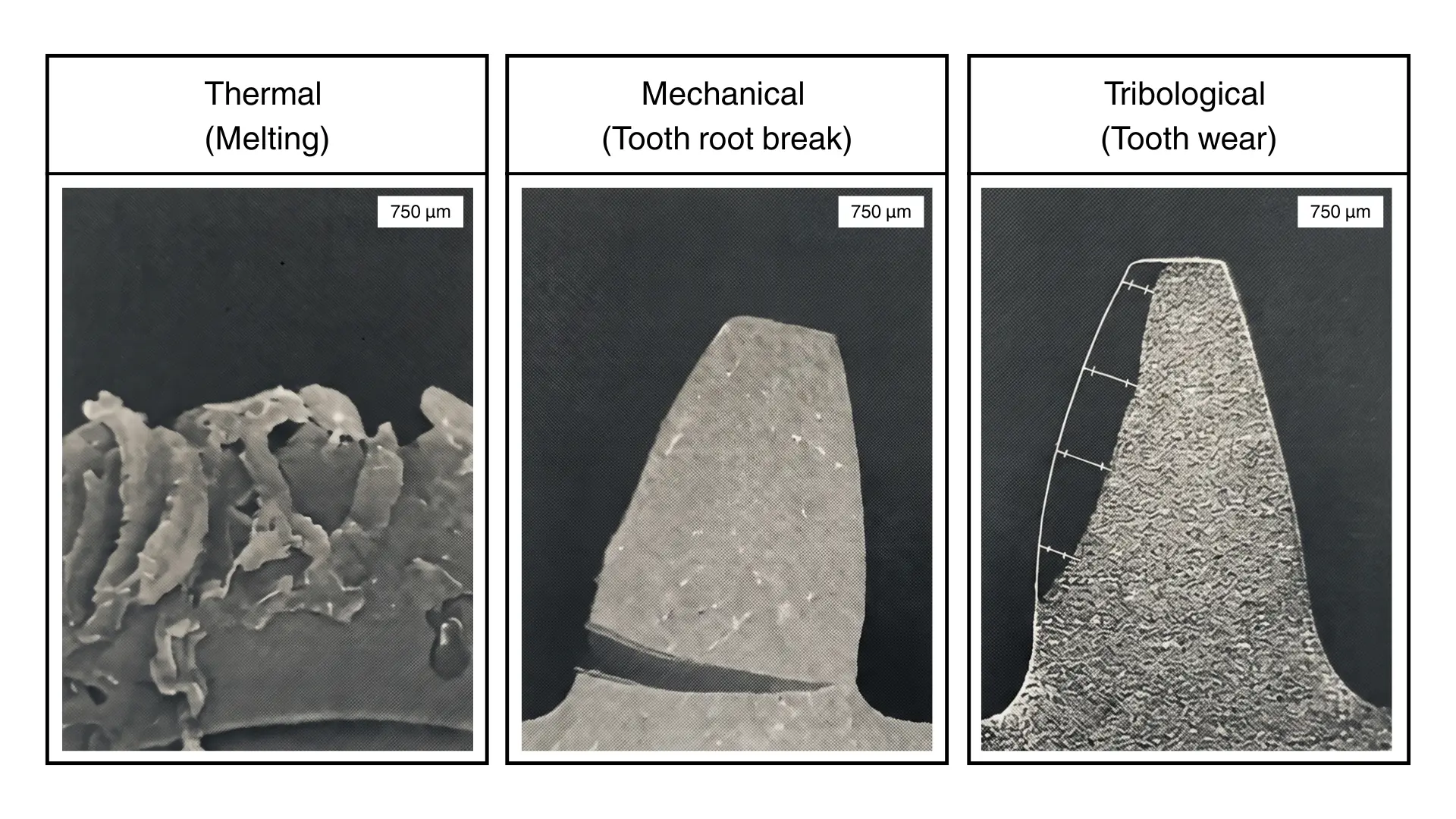
Appearance: streaks parallel to the sliding direction, often with patchy dark or shiny zones. The surface looks smeared or dirtied. In technopolymers it's common to find residues of melted material in the cavities between teeth.
Diagnosis: localized surface melting. The temperature in the contact zone has exceeded the softening temperature of the polymer, melting it locally.
Probable cause: excessive operating temperature, insufficient flank backlash up to seizing, absent or inadequate lubrication.
Action: verify the backlash, check the ambient and operating temperature, evaluate a hybrid pairing (technopolymer-metal or with thermal additives) to improve heat dissipation.
Root fracture
Appearance: the tooth is completely detached from the gear wheel, with a fracture surface at the base.
Diagnosis: exceeding the yield limit in bending.
Probable cause: a sudden load peak or shock not foreseen at the design stage.
Action: verify whether the application presents impulsive loads not considered in the sizing. Evaluate a material with greater resilience or a more robust tooth profile.
Plastic deformation
Appearance: the teeth are visibly deformed, bent or with a distorted profile, but not broken.
Diagnosis: exceeding the softening temperature under continued load.
Probable cause: excessive friction from insufficient clearance or wrong lubrication, or ambient temperature higher than foreseen at the design stage.
Action: verify the HDT (Heat Deflection Temperature, the temperature at which the material begins to deform under load) relative to the real operating temperature. Recalculate the minimum clearance.
Diagnostic table
| Visible sign | Technical diagnosis | Probable cause |
|---|---|---|
| Pitting | Surface fatigue of the material | Excessive load or exceeded life cycles |
| Scuffing | Localized surface melting | Excessive temperature or lack of clearance |
| Root fracture | Exceeding the yield limit | Sudden load peak or shock |
| Plastic deformation | Exceeding the softening temperature | Excessive friction or environment too hot |
In our experience, three out of four failures in technopolymers have a thermal root: underestimated temperature, insufficient clearance or absent lubrication. Before hypothesizing mechanical causes, always verify these three variables.
If you have a damaged gear and can't trace the damage to one of the categories described, send a photo to the technical office. We analyze the damage picture and indicate the most probable cause and the corrective action.